Cable External Rotation — end-range hold
The rotator cuff loaded where it actually fails — at the end of the range, decelerating the arm after the ball has gone
How to do it well
The set-up and the rep in full, then the cues the app shows on the exercise card — the short version, for the moment you are standing in front of the bar.
Set-up
Set a cable or band at elbow height. Stand side-on to it with the working arm on the far side, elbow bent to 90° and pinned to the ribs. A rolled towel between the elbow and your side helps keep it there. Forearm across the stomach, holding the handle.
The rep
Keeping the elbow on the ribs, rotate the forearm out away from the body as far as it will go without the elbow leaving your side or the trunk turning. Hold at the end of the range for twenty seconds. Then let the cable pull the arm back across the stomach slowly, over five seconds. Swap sides.
On the exercise card
- Elbow pinned to the ribs
- Rotate out and hold at the end
- Let it pull you back slowly
- Tempo
- 5s to return
What goes wrong, and the fix
| What goes wrong | The fix |
|---|---|
| The elbow drifting away from the body | Then the shoulder is doing a different job. Pin the towel. |
| Turning the trunk to get further | The chest stays facing forward. Only the forearm turns. |
| Too much load | It should be light. If you cannot hold the end of the range for twenty seconds, it is too heavy. |
Make it easier, or harder
- Easier
- A lighter band, or a shorter hold.
- Harder
- With the elbow raised to shoulder height, closer to the throwing position, or a slightly heavier band.
How Train Smart prescribes it
The sets and reps below are the authored starting point. The actual weight you see is calculated from your own last top set and the week you are in within your four-week block.
The rotator cuff works hardest slowing the arm down after the ball has gone: a throw, a bowl, a pass. Six programs put this in the prehab block at the end of the session: AFL, soccer, cricket, netball, general fitness and bodybuilding.
What it trains, and who trains it
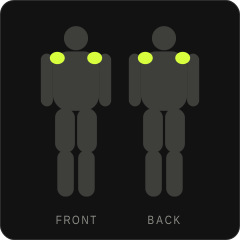
- Muscles worked
- Shoulders
- Region
- Upper body
- Classified as
- Mobility
- Prescribed in
- AFL · soccer · cricket · netball · general fitness · bodybuilding
If you cannot do this one
Rack taken, kit missing, or it does not suit you. These are the swaps the app offers, matched by movement pattern and body region — each with the reason it is a fair substitute.
| Alternative | Why it works as a swap |
|---|---|
| Band Pull-Apart | Rear delts and mid-back — the simplest shoulder insurance going |
| Face Pull | External rotation under load — undoes everything pressing does |
| Cuban Press | Rotate then press: cuff strength through the full overhead range |
| Prone Y-T-W | Lower traps and rear delts with no load to hide behind |
| Band External Rotation | Direct cuff work — the muscle that decelerates a throw |
| Band Internal Rotation | The other half of the cuff, usually skipped |
This exercise, in a program that knows why it is there
Train Smart puts this movement in the right session, at the right point in your block, at a weight calculated for you — and swaps it automatically if you do not have the kit.
Your first month is free, with nothing to pay today. Then A$24.99/month, cancel any time. On the App Store and Google Play.
- Install itFree to download on iPhone and Android.
- Tell it how you playYour sport, your season, the nights you train and the kit you have. No account needed.
- See your week, then start freeYour program is built before you pay anything. Start the free month to unlock it, and cancel any time in your store settings.