Rugby league
training program
Win the collision, repeat high-intensity efforts, and absorb a brutal contact load every set.
Your first month is free, with nothing to pay today. Then A$24.99/month, cancel any time. On the App Store and Google Play.
Train Smart’s rugby league program is a complete weekly strength and conditioning plan periodised to the Australian rugby league season — pre-season November – February, competition March – October. It trains max strength and power, collision tolerance and repeat-effort ability, builds the week around your team nights and game day, prescribes a weight in kilos for every working set, and retests you every four weeks on Bench press 1RM and Back squat 1RM, plus the conditioning benchmark your running plan is built around.
Chasing selection? The rugby league pathway in Australia — what each level tests, and what separates the athletes who move up.
Why this program exists
You train with the team twice a week and get flogged. Then you go to the gym and flog yourself again, because nobody told you that in-season lifting is supposed to be lighter. By mid-season you are carrying a neck, a shoulder and a hamstring, and your Bronco has gone backwards.
League is decided by whether you can win a collision and then do it again forty seconds later. That is max strength and power on one axis, repeat-effort capacity on the other, and the neck and trunk armour that lets you absorb contact without wearing it. The program loads the neck eccentrically as well as isometrically — resisting your head being moved for you is what actually happens in a tackle.
A default rugby league week
This is the sport’s own template — the starting point before it is fitted to your days, your equipment and your season. Team nights and game day are protected; everything else moves to the days you are free.
What rugby league is won with
These are the qualities the program is built to develop, in priority order. They come from the sport, not from a generic template.
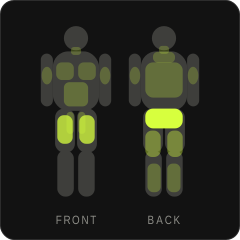
- Max strength + power
- Collision tolerance
- Repeat-effort ability
- Neck + trunk armour
| Session | Type | Duration | Focus |
|---|---|---|---|
| Max Strength (Lower) | Gym | 60–70 min | Build the squat + hinge base for collisions |
| Repeat-Effort Conditioning | Conditioning | 35–45 min | Recover fast between contacts |
| Power & Collision | Gym | 55–65 min | Explosive output + contact prep |
| Captain's Run Primer | Gym | 25–30 min | Light power + activation pre-game |
The season changes the program
League has the longest in-season of any football code here. That makes in-season maintenance the whole game: eight months of collision load with volume that never comes down is how a season ends in round 14.
- Pre-season
- November – February — set volume ×1.2. Build the engine and the strength base.
- In-season
- March – October — set volume ×0.7, prescribed weights hold. Maintain, don’t drain.
- Off-season
- None (a short break only) — baseline volume. Rebuild general strength and fix the niggles.
- Block structure
- Four-week blocks: three weeks accumulating, one week deload. The block’s character changes across the year rather than repeating.
- Game day
- Protected. The day before gets a 20-minute explosive primer with no running, no heavy legs and no prehab block bolted on.
The rugby league testing battery
Five numbers, re-run every four weeks. Chosen to match what rugby league programs actually measure — and the results re-price your training weights and reset your conditioning paces.
| Test | Measures | Unit |
|---|---|---|
| Bronco test | The repeat-effort benchmark both rugby codes are measured on. | mm:ss |
| Bench press 1RM | Upper-body pressing strength: the fend, the tackle, holding a bigger body off. | kg |
| Weighted chin-up 3RM | Pulling strength once bodyweight has stopped being a challenge. | kg added |
| Back squat 1RM | The base of every lower-body quality you have. | kg |
| Standing vertical jump | Lower-body power in its purest form, and the cheapest fatigue check you own. | cm |
What is actually in a rugby league program
Every movement below appears in the sessions above, with the coaching cues the app shows you, the sets and reps it is prescribed at, and ranked alternatives if you cannot do it. The weight is calculated from your own last top set.
| Movement | Appears in | Why it is there | Trains |
|---|---|---|---|
| Adductor Slide-Out — eccentric | Max Strength (Lower) | The groin taken out to length under its own control — the exact mechanism of a reaching tackle or an overstretched stride | Groin / Adductors |
| Back Squat | Max Strength (Lower) | Base strength to win the collision | Quads · Glutes |
| Barbell Hip Thrust | Max Strength (Lower) | Loaded hip extension — the engine behind acceleration | Glutes |
| Bulgarian Split Squat | Max Strength (Lower) | Single-leg power + change of direction | Quads · Glutes |
| Copenhagen Hold (long) | Max Strength (Lower) | Adductor strength at full length — groin strain is a top-three injury in every cutting sport, and this is the position it happens in | Groin / Adductors · Abs / Core |
| Nordic Hamstring Lower | Max Strength (Lower) | The most-evidenced hamstring exercise there is, done as a slow lower into a hold rather than a fall | Hamstrings |
| Romanian Deadlift | Max Strength (Lower) | Posterior chain for driving legs | Hamstrings · Glutes · Back |
| Bench Press | Power & Collision | Pushing strength in contests | Chest · Triceps |
| Front Squat | Power & Collision | Quad and trunk strength in the upright posture sport actually loads | Quads · Glutes |
| Neck Harness Eccentric Lower | Power & Collision | Eccentric neck strength, which is what actually resists the head being moved for you — the collision-code version of a Nordic | Neck |
| Power Clean | Power & Collision | Whole-body explosive power | Quads · Glutes · Hamstrings · Traps |
| Sled Push (heavy) | Power & Collision | Direct transfer to the leg drive in a tackle | Quads · Glutes · Calves |
| Trap Bar Jump | Power & Collision | A loaded jump — peak power output with no barbell skill to learn first | Quads · Glutes · Calves |
| Weighted Pull-Up | Power & Collision | Wrestle + grip strength | Back · Biceps |
| Weighted Side Plank — long hold | Power & Collision | Lateral trunk endurance under load — the side that gives way in a fast bowler's side strain and in every one-armed carry | Abs / Core |
Staying available
The prehab block is matched to the region of the session it sits in and to the tissue this sport actually punishes — not a generic mobility flow bolted to the front.
Prehab only works if it happens, and the reason it usually does not is that it has nothing to do with the session it is attached to. Rotating a pool by session number puts shoulder work before a squat day and Copenhagen planks before a bench press. Technically covered; nobody does it.
In Train Smart each movement is classified by the region it protects and matched to the session, and the pool rotates across the week so you cover all of it rather than doing the same three moves three times.
More on prehab that people actually do →
What the free month covers, and what comes after
The first month is one complete four-week block — three building weeks and a deload. The first retest comes after that block, and it is the first time the program measures what your training did.
- Week 1
- Testing session on the rugby league battery. Your starting weights and paces come from it.
- Weeks 1–3
- The first block builds. Hit your reps and the weight goes up on its own.
- Week 4
- Deload — the week the previous three become fitness.
- Week 5
- Retest. The results re-price your weights and reset your conditioning paces.
- Weeks 5–8
- Block two changes shape, priced from the top sets you just did and the numbers you just tested.
Rugby league guides for your part of Australia
The pathway club your address is zoned to, the leagues you play in, when your season really starts and what the weather does to a pre-season — region by region, with sources.
Rugby league training questions
What does the Train Smart rugby league program include?
When is rugby league pre-season?
Can I follow this program if I only train twice a week?
What tests does the rugby league program use?
Do I need a full gym?
Related
Prescribed weights
How every set gets a number in kilos, and why it climbs on its own.
OpenConditioning plans
Goal-driven running with a working pace recalculated every week.
OpenThe rugby league pathway
How selection works in Australia, what gets tested, and what separates athletes who move up.
OpenGet your rugby league program
Pick rugby league, answer eight questions, and your week is built — around your team nights, your game and the days you can actually train.
Your first month is free, with nothing to pay today. Then A$24.99/month, cancel any time. On the App Store and Google Play.
- Install itFree to download on iPhone and Android.
- Tell it how you playYour sport, your season, the nights you train and the kit you have. No account needed.
- See your week, then start freeYour program is built before you pay anything. Start the free month to unlock it, and cancel any time in your store settings.