Back exercises, and what each pattern is for
The back is where a lot of sport programs quietly underperform, because pressing is easier to measure and easier to enjoy. The programs here run pulling volume at least equal to pressing volume in every sport, for reasons that have as much to do with the shoulder staying healthy as with how hard an athlete can pull.
Back training in a sport program splits into two patterns that are not interchangeable. Vertical pulling (pull-ups, chin-ups, pulldowns) builds overhead and wrestling strength. Horizontal pulling (barbell rows, chest-supported rows, single-arm rows) builds the pulling strength used in contact, tackling and grappling, and balances the pressing volume that would otherwise pull the shoulders forward.
Train Smart programs both patterns in every sport, and prescribes carries and isometric holds alongside them for the grip and trunk work they force.
What back training is for in a sport program
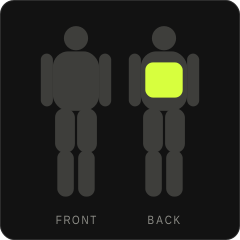
Vertical pulling. Pull-ups, chin-ups and their assisted regressions build strength through a range the shoulder has to be strong in — overhead and loaded. In contact sports they carry over directly; in gymnastics and bodyweight training they are the program.
Horizontal pulling. Rows are the counterweight to bench pressing. Programmed at matching or higher volume, they keep the shoulder girdle balanced and build the pull used in a tackle and a scrum.
Carries and holds. Farmer's carries, suitcase carries and dead hangs appear for what they load that a row does not: grip, trunk anti-lateral-flexion, and the ability to hold a position while fatigued.
28 back movements in Train Smart
Every one of these is prescribed in at least one sport program, carries coaching cues written for the moment you are standing in front of it, and lists ranked alternatives. The sets, reps and load each is programmed at are on its own page.
Lower body
| Movement | Why it is in the program | Also trains |
|---|---|---|
| Trap Bar Jump | A loaded jump — peak power output with no barbell skill to learn first | Hamstrings · Glutes |
| Romanian Deadlift | Posterior chain for driving legs | Hamstrings · Glutes |
| Trap Bar Deadlift | Foundational power output | Hamstrings · Glutes |
| Deadlift | Maul + cleanout drive | Hamstrings · Glutes |
| KB Swing | Explosive hip power + conditioning | Hamstrings · Glutes |
| Kettlebell Swing | Repeatable hip-extension power that also banks conditioning | Hamstrings · Glutes |
| Single-Leg RDL — hold at length | Hamstring length under load on one leg, held at the end of the range where strains happen | Hamstrings · Glutes |
Upper body
| Movement | Why it is in the program | Also trains |
|---|---|---|
| Weighted Chin-Up | Contested marking + tackle strength | Biceps |
| Weighted Pull-Up | Wrestle + grip strength | Biceps |
| Chest-Supported Row | Upper-back strength + posture | Biceps |
| Lat Pulldown | Back width + pulling strength | Biceps |
| Barbell Row | Mid-back strength — what holds posture together late in a game | Biceps |
| Chin-Up (or Band-Assisted) | The best test of upper-body relative strength | Biceps |
| DB Bent-Over Row | Posterior chain + back health | Biceps |
| Eccentric Chin-Up — dead-hang finish | Loads the elbow and biceps tendon at full length under control — the tendon that complains in every grappling, climbing and bar sport | Biceps |
| Gi / Towel Row | Grip + back endurance specific to grappling | Biceps |
| Inverted Row (under a table or bar) | Back + biceps strength — no bar? use a sturdy table edge | Biceps |
Full body and explosive
| Movement | Why it is in the program | Also trains |
|---|---|---|
| Weighted Dead Hang | Decompresses the spine and loads the shoulder at full overhead range — the cheapest overhead flexibility work there is | Biceps |
| DB Pullover — stretch hold | Lat length and thoracic extension held at end range — overhead room for reaching, marking and throwing | — |
| Farmer Carry | Grip and a braced trunk under a load that is genuinely heavy | Hamstrings · Glutes |
| Neck Harness Eccentric Lower | Eccentric neck strength, which is what actually resists the head being moved for you — the collision-code version of a Nordic | Shoulders |
| Loaded Thoracic Rotation Hold | Rotation range from the mid-back rather than the low back — the difference between a shoulder that turns and a lumbar spine that pays for it | — |
| Plate Neck Iso Hold (4-way) | A stronger neck reduces the head acceleration behind contact injuries, and an isometric hold is how it is safely loaded | Shoulders |
| Heavy Sled Drive | Scrum/maul leg drive | Hamstrings · Glutes |
| MB Rotational Throw | Hitting + slap-shot power | Biceps |
| Sled Push (heavy) | Direct transfer to the leg drive in a tackle | Hamstrings · Glutes |
Trunk
| Movement | Why it is in the program | Also trains |
|---|---|---|
| Jefferson Curl (light KB) | Loads spinal flexion and hamstring length together, then holds there — the range you land and bend in, owned rather than avoided | Hamstrings · Glutes |
| Heavy Suitcase Hold | The trunk resisting a sideways pull, held — the shape of every one-sided carry, collision and pull in sport | Hamstrings · Glutes |
Which programs lean on the backs hardest
Counted from the movements above — how many of them appear in each sport's own sessions. It is a measure of emphasis, not of importance.
| Program | Back movements in it |
|---|---|
| general fitness | 12 |
| rugby union | 8 |
| MMA | 7 |
| bodybuilding | 7 |
| AFL | 6 |
| boxing | 6 |
| bodyweight training | 6 |
| rugby league | 5 |
The tests that reflect back training
Train Smart re-runs a five-test battery every eight weeks and re-prices your training weights from the results. These are the tests in it that this work moves.
Back training questions
How many back exercises should be in a week?
What weight should I use for back exercises?
Can I swap one of these back exercises out?
Back work, in a program that knows where it goes
Train Smart puts these movements in the right session, at the right point in your four-week block, at a weight calculated from your own last top set — and swaps them automatically if you do not have the kit.
One month free, then A$24.99/month. Cancel any time. iPhone and iPad.