Bodybuilding
training program
Build visible muscle and symmetry with a focused body-part split — hit each muscle group hard, then recover and grow.
Your first month is free, with nothing to pay today. Then A$24.99/month, cancel any time. On the App Store and Google Play.
Train Smart’s bodybuilding program is a complete weekly plan built around the days and equipment you have. It trains muscle size and symmetry, mind-muscle connection and progressive overload, prescribes a weight in kilos for every working set, runs four-week blocks that build and then deload, and retests you every four weeks on Bench press 1RM and Back squat 1RM, plus the conditioning benchmark your running plan is built around.
Why this program exists
Every split online is a list of exercises with no weights and no plan for what happens in week three. Progressive overload is left entirely to you, which is why most people run the same weights for a year.
Pick from ten proven splits — push/pull/legs, upper/lower, bro split, V-taper, glute-focused and more — or build your own week by choosing which muscles pair up on which day. Then the program handles the part that actually causes growth: the weight goes up, week over week, without you planning it.
A default bodybuilding week
This is the sport’s own template — the starting point before it is fitted to your days, your equipment and your season. Team nights and game day are protected; everything else moves to the days you are free.
What bodybuilding is won with
These are the qualities the program is built to develop, in priority order. They come from the sport, not from a generic template.
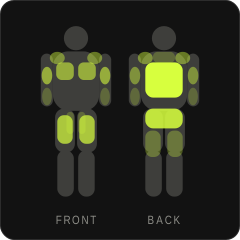
- Muscle size + symmetry
- Mind-muscle connection
- Progressive overload
- Low body fat
| Session | Type | Duration | Focus |
|---|---|---|---|
| Push — Chest, Shoulders, Triceps | Gym | 55–70 min | Hypertrophy for the pressing muscles |
| Pull — Back, Rear Delts, Biceps | Gym | 55–70 min | Hypertrophy for the pulling muscles |
| Legs — Quads, Hams, Glutes, Calves | Gym | 55–70 min | Full lower-body hypertrophy |
| Lean-Down Cardio | Conditioning | 20–45 min | Burn fat without burning muscle |
| Shoulders + Arms | Gym | 45–60 min | Bring up the showpiece muscles |
The bodybuilding testing battery
Five numbers, re-run every four weeks. Chosen to match what bodybuilding programs actually measure — and the results re-price your training weights and reset your conditioning paces.
| Test | Measures | Unit |
|---|---|---|
| 2km time trial | The aerobic benchmark your program is built around. | mm:ss |
| Bench press 1RM | Upper-body pressing strength: the fend, the tackle, holding a bigger body off. | kg |
| Max pull-ups | Relative pulling strength — the best upper-body number there is for a field athlete. | reps |
| Back squat 1RM | The base of every lower-body quality you have. | kg |
| Standing vertical jump | Lower-body power in its purest form, and the cheapest fatigue check you own. | cm |
What is actually in a bodybuilding program
Every movement below appears in the sessions above, with the coaching cues the app shows you, the sets and reps it is prescribed at, and ranked alternatives if you cannot do it. The weight is calculated from your own last top set.
| Movement | Appears in | Why it is there | Trains |
|---|---|---|---|
| Back Squat | Legs — Quads, Hams, Glutes, Calves | Base strength to win the collision | Quads · Glutes |
| Barbell Hip Thrust | Legs — Quads, Hams, Glutes, Calves | Loaded hip extension — the engine behind acceleration | Glutes |
| Bulgarian Split Squat | Legs — Quads, Hams, Glutes, Calves | Single-leg power + change of direction | Quads · Glutes |
| Goblet Cossack Squat — deep hold | Legs — Quads, Hams, Glutes, Calves | Adductor and hip length under load, held in the deepest position — the shape a cut or a lunge actually asks for | Groin / Adductors · Quads · Glutes |
| Reverse Nordic — hold at length | Legs — Quads, Hams, Glutes, Calves | Quad and hip-flexor length under load — the other half of the Nordic, and the range a sprinter runs out of first | Quads |
| Romanian Deadlift | Legs — Quads, Hams, Glutes, Calves | Posterior chain for driving legs | Hamstrings · Glutes · Back |
| Sissy Squat — bottom hold | Legs — Quads, Hams, Glutes, Calves | Loads the quad and the knee in full flexion — the position a deep landing, a lunge for a ball or a low turn puts it in | Quads |
| Cable External Rotation — end-range hold | Pull — Back, Rear Delts, Biceps | The rotator cuff loaded where it actually fails — at the end of the range, decelerating the arm after the ball has gone | Shoulders |
| Chest-Supported Row | Pull — Back, Rear Delts, Biceps | Upper-back strength to balance thousands of punches — posture for the guard | Back · Biceps |
| Dip — bottom stretch hold | Pull — Back, Rear Delts, Biceps | Pec and front-shoulder length under real load — the range a press never visits and a fall or a hand-off finds immediately | Chest · Triceps |
| Lat Pulldown | Pull — Back, Rear Delts, Biceps | Back width + pulling strength | Back · Biceps |
| Prone Trap-3 Shoulder Raise — top hold | Pull — Back, Rear Delts, Biceps | The lower trap, which sets the shoulder blade for every overhead action and switches off first when the shoulder is sore | Traps · Shoulders |
| Barbell Bench Press | Push — Chest, Shoulders, Triceps | Primary chest mass + pressing strength | Chest · Triceps |
| DB Fly — stretch hold | Push — Chest, Shoulders, Triceps | Pec length at end range under load — the tissue that shortens on everyone who benches and presses | Chest |
| DB Pullover — stretch hold | Push — Chest, Shoulders, Triceps | Lat length and thoracic extension held at end range — overhead room for reaching, marking and throwing | Back |
| Incline DB Press | Push — Chest, Shoulders, Triceps | Upper strength for shielding the ball | Chest · Triceps |
| Seated DB Shoulder Press | Push — Chest, Shoulders, Triceps | Overhead strength for contests, marks and intercepts | Shoulders |
| Weighted Dead Hang | Push — Chest, Shoulders, Triceps | Decompresses the spine and loads the shoulder at full overhead range — the cheapest overhead flexibility work there is | Back · Biceps |
| EZ-Bar Curl | Shoulders + Arms | Biceps mass | Biceps |
| Jefferson Curl (light KB) | Shoulders + Arms | Loads spinal flexion and hamstring length together, then holds there — the range you land and bend in, owned rather than avoided | Hamstrings · Glutes · Back |
| Loaded Thoracic Rotation Hold | Shoulders + Arms | Rotation range from the mid-back rather than the low back — the difference between a shoulder that turns and a lumbar spine that pays for it | Back |
| Wrist Extensor Eccentric — end-range hold | Shoulders + Arms | The wrist and forearm loaded eccentrically — the only thing shown to fix a stubborn tennis elbow, and the joint every hand-plant and stick sport punishes | Forearms |
Staying available
The prehab block is matched to the region of the session it sits in and to the tissue this sport actually punishes — not a generic mobility flow bolted to the front.
Prehab only works if it happens, and the reason it usually does not is that it has nothing to do with the session it is attached to. Rotating a pool by session number puts shoulder work before a squat day and Copenhagen planks before a bench press. Technically covered; nobody does it.
In Train Smart each movement is classified by the region it protects and matched to the session, and the pool rotates across the week so you cover all of it rather than doing the same three moves three times.
More on prehab that people actually do →
What the free month covers, and what comes after
The first month is one complete four-week block — three building weeks and a deload. The first retest comes after that block, and it is the first time the program measures what your training did.
- Week 1
- Testing session on the bodybuilding battery. Your starting weights and paces come from it.
- Weeks 1–3
- The first block builds. Hit your reps and the weight goes up on its own.
- Week 4
- Deload — the week the previous three become fitness.
- Week 5
- Retest. The results re-price your weights and reset your conditioning paces.
- Weeks 5–8
- Block two changes shape, priced from the top sets you just did and the numbers you just tested.
Bodybuilding training questions
What does the Train Smart bodybuilding program include?
Can I follow this program if I only train twice a week?
What tests does the bodybuilding program use?
Do I need a full gym?
Related
Get your bodybuilding program
Pick bodybuilding, answer eight questions, and your week is built — around your team nights, your game and the days you can actually train.
Your first month is free, with nothing to pay today. Then A$24.99/month, cancel any time. On the App Store and Google Play.
- Install itFree to download on iPhone and Android.
- Tell it how you playYour sport, your season, the nights you train and the kit you have. No account needed.
- See your week, then start freeYour program is built before you pay anything. Start the free month to unlock it, and cancel any time in your store settings.