Hamstring exercises, and why the eccentric ones matter
The hamstring is the most commonly strained muscle in running sports, and it is strained almost exclusively at one moment — late swing phase in a sprint, when the muscle is long and braking. That is a specific quality, and it is trained by a specific kind of work.
Hamstring training in a sport program does two separate jobs: producing force at the hip (Romanian deadlifts, hip hinges, good mornings) and resisting lengthening under load at speed (Nordic curls, eccentric leg curls, sprint-specific work). The second is the one most programs skip, and it is the one associated with hamstring strain risk in running sports.
Train Smart programs eccentric hamstring work year-round in every running sport, at a volume that changes with the season rather than disappearing in-season.
What hamstring training is for in a sport program
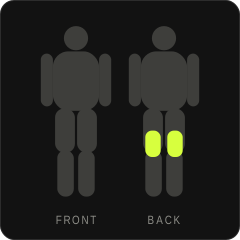
Eccentric strength at length. The Nordic hamstring curl and its regressions are in the program because of what they load: the hamstring lengthening under tension. This is the quality that the sprint stride demands and that a seated leg curl does not build. Train Smart keeps this in the week all year, and it is one of the few things that is not cut when in-season volume drops.
Hip extension. Romanian deadlifts, hip hinges and good mornings train the hamstring as a hip extensor alongside the glute. This is the force side of the equation and it is what carries over to acceleration.
Why volume is managed carefully. Eccentric work produces more soreness than concentric work at the same load, and soreness on a game weekend is a real cost. The programs place it in the week relative to game day rather than on a fixed day.
17 hamstring movements in Train Smart
Every one of these is prescribed in at least one sport program, carries coaching cues written for the moment you are standing in front of it, and lists ranked alternatives. The sets, reps and load each is programmed at are on its own page.
Lower body
| Movement | Why it is in the program | Also trains |
|---|---|---|
| Trap Bar Jump | A loaded jump — peak power output with no barbell skill to learn first | Glutes · Back |
| Romanian Deadlift | Posterior chain for driving legs | Glutes · Back |
| Nordic Curl | Hamstring injury prevention — the #1 AFL injury | — |
| Nordic Hamstring Lower | The most-evidenced hamstring exercise there is, done as a slow lower into a hold rather than a fall | — |
| Trap Bar Deadlift | Foundational power output | Glutes · Back |
| Seated Straddle Good Morning | Adductors and hamstrings at length together — the wide, low position a slide tackle or a low ball ends up in | — |
| Sliding Leg Curl — eccentric hold | Hamstring eccentric with the hip extended — the sprinting position, which a Nordic on its knees never loads | — |
| Deadlift | Maul + cleanout drive | Glutes · Back |
| KB Swing | Explosive hip power + conditioning | Glutes · Back |
| Kettlebell Swing | Repeatable hip-extension power that also banks conditioning | Glutes · Back |
| Nordic Curl (or Sliding Leg Curl) | Hamstring strength that prevents the #1 athletic injury | — |
| Single-Leg RDL — hold at length | Hamstring length under load on one leg, held at the end of the range where strains happen | Glutes · Back |
Full body and explosive
| Movement | Why it is in the program | Also trains |
|---|---|---|
| Farmer Carry | Grip and a braced trunk under a load that is genuinely heavy | Glutes · Back |
| Heavy Sled Drive | Scrum/maul leg drive | Glutes · Back |
| Sled Push (heavy) | Direct transfer to the leg drive in a tackle | Glutes · Back |
Trunk
| Movement | Why it is in the program | Also trains |
|---|---|---|
| Jefferson Curl (light KB) | Loads spinal flexion and hamstring length together, then holds there — the range you land and bend in, owned rather than avoided | Glutes · Back |
| Heavy Suitcase Hold | The trunk resisting a sideways pull, held — the shape of every one-sided carry, collision and pull in sport | Glutes · Back |
Which programs lean on the hamstrings hardest
Counted from the movements above — how many of them appear in each sport's own sessions. It is a measure of emphasis, not of importance.
| Program | Hamstrings movements in it |
|---|---|
| hockey | 6 |
| general fitness | 6 |
| AFL | 5 |
| rugby union | 5 |
| rugby league | 4 |
| soccer | 4 |
| MMA | 4 |
| dance | 4 |
The tests that reflect hamstring training
Train Smart re-runs a five-test battery every eight weeks and re-prices your training weights from the results. These are the tests in it that this work moves.
Hamstrings training questions
How many hamstring exercises should be in a week?
What weight should I use for hamstring exercises?
Can I swap one of these hamstring exercises out?
Hamstrings work, in a program that knows where it goes
Train Smart puts these movements in the right session, at the right point in your four-week block, at a weight calculated from your own last top set — and swaps them automatically if you do not have the kit.
One month free, then A$24.99/month. Cancel any time. iPhone and iPad.