Kettlebell Swing
Repeatable hip-extension power that also banks conditioning
How to do it well
The set-up and the rep in full, then the cues the app shows on the exercise card — the short version, for the moment you are standing in front of the bar.
Set-up
Place the bell about a foot in front of you, feet a little wider than the hips. Hinge down with a flat back, grip the handle with both hands, and tilt the bell back towards you.
The rep
Hike the bell back between the thighs like a centre snapping a ball, forearms against the inside of the thighs. Then snap the hips forward hard and stand tall, glutes squeezed, ribs down, knees straight, so the bell floats up to about chest height on its own. Let it fall back, wait for it, and hinge again only as the forearms reach the hips. The arms guide the bell; they never lift it.
On the exercise card
- Snap the hips, float the bell
- Ribs down at the top
What goes wrong, and the fix
| What goes wrong | The fix |
|---|---|
| Squatting the swing | The knees bend a little, but it is a hip hinge. Push the hips back, not down. |
| Lifting the bell with the arms | If the shoulders are working, the hips are not. Snap harder and let the bell float. |
| Leaning back at the top | Finish standing straight with the ribs down and the glutes tight. Leaning back loads the lower back. |
| Hinging too early | Wait for the bell to fall back to the hips before you hinge, or it pulls you forward. |
Make it easier, or harder
- Easier
- A lighter bell, or kettlebell deadlifts to learn the hinge first.
- Harder
- A heavier bell, single-arm swings, or longer sets when the goal is conditioning.
How Train Smart prescribes it
The sets and reps below are the authored starting point. The actual weight you see is calculated from your own last top set and the week you are in within your four-week block.
It trains the same hip extension as a jump or a sprint, but in a way you can repeat, so it builds conditioning alongside power. The bodyweight program uses it because one kettlebell is all the kit it needs. It sits in the athletic power session at eight reps, with sprints and jumps.
| Program | Session | Sets × reps | Load |
|---|---|---|---|
| Bodyweight Athlete | Athletic Power + Core | 4 × 8 | Moderate KB |
What it trains, and who trains it
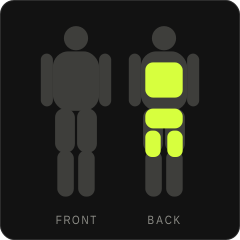
- Muscles worked
- Hamstrings · Glutes · Back
- Region
- Lower body
- Classified as
- Power
- Prescribed in
- bodyweight training
If you cannot do this one
Rack taken, kit missing, or it does not suit you. These are the swaps the app offers, matched by movement pattern and body region — each with the reason it is a fair substitute.
| Alternative | Why it works as a swap |
|---|---|
| Trap Bar Deadlift | Big posterior-chain pull, back-friendly — sprinter strength gold standard |
| Romanian Deadlift | Hamstring + glute loaded stretch — anti-injury for soccer/AFL |
| Conventional Deadlift | Full-body max strength pull |
| Sumo Deadlift | Wide stance, more glute/adductor — hip-driven athletes |
| Deficit Deadlift | Standing on a plate — longer pull, more eccentric for hamstring resilience |
| Snatch-Grip RDL | Wider grip + bigger upper-back demand — Olympic lifters, throwers |
This exercise, in a program that knows why it is there
Train Smart puts this movement in the right session, at the right point in your block, at a weight calculated for you — and swaps it automatically if you do not have the kit.
Your first month is free, with nothing to pay today. Then A$24.99/month, cancel any time. On the App Store and Google Play.
- Install itFree to download on iPhone and Android.
- Tell it how you playYour sport, your season, the nights you train and the kit you have. No account needed.
- See your week, then start freeYour program is built before you pay anything. Start the free month to unlock it, and cancel any time in your store settings.