Glute exercises, and what they are actually for
The glutes show up in more Train Smart sessions than any other muscle group, and not because of how they look. Hip extension is how an athlete accelerates, how they leave the ground, and how they absorb load when they land — and the hip is where the power to do all three is produced.
The glutes are the primary hip extensors, which makes them the engine behind sprinting, jumping and change of direction. In training they are loaded two ways that do different jobs: bilateral hip extension under heavy load (hip thrust, trap-bar deadlift, squat variants) for raw force, and single-leg work (split squats, step-ups, single-leg bridges) for the unilateral stability a running stride actually demands.
Train Smart prescribes glute work in every sport it covers, because there is no field or court sport where hip extension is not a limiting quality.
What glute training is for in a sport program
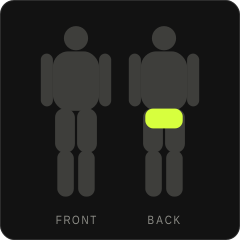
Acceleration. The first few steps out of a standstill are hip extension against the ground. This is why the programs load heavy bilateral hip extension in pre-season and keep a lighter version of it in-season — sprint speed decays faster than almost anything else when it stops being trained.
Landing and change of direction. A glute that can only produce force concentrically is half-trained. Single-leg and eccentric work is in the program because deceleration — stopping, cutting, landing — is where the hip is loaded hardest and where the knee pays for a hip that gives way.
Why single-leg work is not optional. Running is a series of single-leg landings. Bilateral lifts build the force; unilateral lifts build the ability to express it on one leg without the pelvis dropping. The programs run both, and the split changes with the block.
50 glute movements in Train Smart
Every one of these is prescribed in at least one sport program, carries coaching cues written for the moment you are standing in front of it, and lists ranked alternatives. The sets, reps and load each is programmed at are on its own page.
Lower body
| Movement | Why it is in the program | Also trains |
|---|---|---|
| Front Squat | Quad and trunk strength in the upright posture sport actually loads | Quads |
| Trap Bar Jump | A loaded jump — peak power output with no barbell skill to learn first | Hamstrings · Back |
| Romanian Deadlift | Posterior chain for driving legs | Hamstrings · Back |
| Bulgarian Split Squat | Single-leg power + change of direction | Quads |
| Copenhagen Hold (long) | Adductor strength at full length — groin strain is a top-three injury in every cutting sport, and this is the position it happens in | Quads |
| Trap Bar Deadlift | Foundational power output | Hamstrings · Back |
| Back Squat | Base strength to win the collision | Quads |
| Broad Jump | Horizontal shot power on the double-leg | Quads · Shoulders |
| Goblet Cossack Squat — deep hold | Adductor and hip length under load, held in the deepest position — the shape a cut or a lunge actually asks for | Quads |
| Goblet Squat | Base leg strength | Quads |
| Hang Power Clean | Triple extension = sprint acceleration | Quads · Shoulders |
| Hang Power Snatch | The fastest lift in the gym — trains rate of force development directly | Quads · Shoulders |
| Barbell Hip Thrust | Loaded hip extension — the engine behind acceleration | — |
| Box Jump | Vertical power for marking + ruck taps | Quads · Shoulders |
| Deep Goblet Squat Hold | Loaded end-range hip, knee and ankle at once — the bottom position, held long enough to change it | Quads |
| Lateral Bound | Change-of-direction power | Quads · Shoulders |
| Lateral Bound → Stick | Controlled change of direction | Quads · Shoulders |
| Loaded Adductor Frog Hold | Deep abduction and adductor length held long enough to change it — the base position for guard work, low blocks and wide bases | Quads |
| Power Clean | Whole-body explosive power | Quads · Shoulders |
| Adductor Slide-Out — eccentric | The groin taken out to length under its own control — the exact mechanism of a reaching tackle or an overstretched stride | Quads |
| Barbell Back Squat | Base lower-body strength — bowling drive + batting stance | Quads |
| Countermovement Jump | Builds the jump height behind leaps + grand jetés | Quads · Shoulders |
| Deadlift | Maul + cleanout drive | Hamstrings · Back |
| Depth Drop → Rebound | Reactive power off the floor | Quads · Shoulders |
| Depth Drop → Stick | Deceleration + ACL-safe landing | Quads · Shoulders |
| Drop Landing → Stick | Trains the safe landing that prevents ACL tears | Quads · Shoulders |
| KB Swing | Explosive hip power + conditioning | Hamstrings · Back |
| Kettlebell Swing | Repeatable hip-extension power that also banks conditioning | Hamstrings · Back |
| Overhead Squat Hold | Ankle, hip and shoulder range in one chain, held long enough to expose and then change the limiting one | Quads |
| Pause Squat Jump | Concentric-only jump — pure starting strength | Quads |
| Single-Leg Hip Thrust | Glute + hamstring strength for sprint power | — |
| Single-Leg Hop → Stick | Single-leg landing control on the catch | Quads · Shoulders |
| Single-Leg RDL — hold at length | Hamstring length under load on one leg, held at the end of the range where strains happen | Hamstrings · Back |
| Spanish Squat — long isometric | A long knee-extensor isometric, the first-line loading for a sore patellar tendon and the cheapest jumper's-knee insurance there is | Quads |
| Split Jump → Stick | Trains the soft, controlled landing that protects ankles + knees | Quads · Shoulders |
| Sprint | Top-end speed — the most athletic quality there is | Quads |
| Squat Jump | Explosive leg power for jumping + sprinting | Quads |
| Tuck Jump | Reactive power + fast feet | Quads · Shoulders |
| Vertical Jump → Stick | Triple-extension power that feeds punch force | Quads · Shoulders |
Full body and explosive
| Movement | Why it is in the program | Also trains |
|---|---|---|
| Farmer Carry | Grip and a braced trunk under a load that is genuinely heavy | Hamstrings · Back |
| Loaded 90/90 — hold each side | Internal and external hip rotation held at end range — the range that runs out first in cutting sports | Quads |
| Weighted Pigeon Hold | External hip rotation at full length under load — what a deep lunge, a turn-out and a guard position all run out of | — |
| Heavy Sled Drive | Scrum/maul leg drive | Hamstrings · Back |
| KB Windmill — bottom hold | Hip hinge, thoracic rotation and an overhead shoulder held in one shape | Quads |
| MB Rotational Slam | The hip rotation behind a heavy cross + hook | Quads · Shoulders |
| Med Ball Overhead Slam | Full-body extension into the ground, and it stays honest under fatigue | Quads · Shoulders |
| Sled Push (heavy) | Direct transfer to the leg drive in a tackle | Hamstrings · Back |
| Slow Eccentric Step-Down | Eccentric knee control on one leg — the quality that decides whether a landing or a deceleration is absorbed or survived | Quads |
Trunk
| Movement | Why it is in the program | Also trains |
|---|---|---|
| Jefferson Curl (light KB) | Loads spinal flexion and hamstring length together, then holds there — the range you land and bend in, owned rather than avoided | Hamstrings · Back |
| Heavy Suitcase Hold | The trunk resisting a sideways pull, held — the shape of every one-sided carry, collision and pull in sport | Hamstrings · Back |
Which programs lean on the glutes hardest
Counted from the movements above — how many of them appear in each sport's own sessions. It is a measure of emphasis, not of importance.
| Program | Glutes movements in it |
|---|---|
| bodyweight training | 13 |
| rugby league | 10 |
| rugby union | 10 |
| cricket | 10 |
| general fitness | 10 |
| MMA | 9 |
| dance | 9 |
| AFL | 7 |
The tests that reflect glute training
Train Smart re-runs a five-test battery every eight weeks and re-prices your training weights from the results. These are the tests in it that this work moves.
Glutes training questions
How many glute exercises should be in a week?
What weight should I use for glute exercises?
Can I swap one of these glute exercises out?
Glutes work, in a program that knows where it goes
Train Smart puts these movements in the right session, at the right point in your four-week block, at a weight calculated from your own last top set — and swaps them automatically if you do not have the kit.
One month free, then A$24.99/month. Cancel any time. iPhone and iPad.