Shoulder exercises, from pressing to cuff work
The shoulder is the most mobile joint in the body and pays for it. In throwing, swimming, contact and overhead sports it is the joint most likely to end a season, and the work that protects it is unglamorous, low-load and has to be done at a frequency no separate routine survives.
Shoulder training in a sport program covers three distinct jobs: overhead pressing strength (military press, push press, landmine press), deltoid work for the mass and the position (lateral raises, rear-delt work), and rotator cuff and scapular prehab (external rotations, band pull-aparts, Y-T-W raises) that keeps the joint tolerating the first two.
Train Smart programs cuff and scapular work as prehab attached to upper-body sessions rather than as a separate routine, because prehab that lives in its own session is the prehab that does not happen.
What shoulder training is for in a sport program
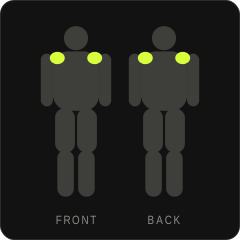
Pressing. Overhead strength is a real quality in contact and overhead sports and a useful one everywhere else. Which press appears depends on what the athlete's shoulder tolerates — a landmine or a neutral-grip press where full overhead range is not available.
The cuff and the scapula. External rotations, band pull-aparts and Y-T-W work sit in the prehab block attached to upper-body days. They are matched to the region of the session they attach to, which is the difference between prehab that gets done and prehab that gets skipped.
Rear delts and balance. Rear-delt and face-pull work is programmed against pressing volume, because the position a heavy pressing block pulls the shoulders into is the position that makes the joint hurt.
27 shoulder movements in Train Smart
Every one of these is prescribed in at least one sport program, carries coaching cues written for the moment you are standing in front of it, and lists ranked alternatives. The sets, reps and load each is programmed at are on its own page.
Lower body
| Movement | Why it is in the program | Also trains |
|---|---|---|
| Broad Jump | Horizontal shot power on the double-leg | Quads · Glutes |
| Hang Power Clean | Triple extension = sprint acceleration | Quads · Glutes |
| Hang Power Snatch | The fastest lift in the gym — trains rate of force development directly | Quads · Glutes |
| Box Jump | Vertical power for marking + ruck taps | Quads · Glutes |
| Lateral Bound | Change-of-direction power | Quads · Glutes |
| Lateral Bound → Stick | Controlled change of direction | Quads · Glutes |
| Power Clean | Whole-body explosive power | Quads · Glutes |
| Countermovement Jump | Builds the jump height behind leaps + grand jetés | Quads · Glutes |
| Depth Drop → Rebound | Reactive power off the floor | Quads · Glutes |
| Depth Drop → Stick | Deceleration + ACL-safe landing | Quads · Glutes |
| Drop Landing → Stick | Trains the safe landing that prevents ACL tears | Quads · Glutes |
| Single-Leg Hop → Stick | Single-leg landing control on the catch | Quads · Glutes |
| Split Jump → Stick | Trains the soft, controlled landing that protects ankles + knees | Quads · Glutes |
| Tuck Jump | Reactive power + fast feet | Quads · Glutes |
| Vertical Jump → Stick | Triple-extension power that feeds punch force | Quads · Glutes |
Upper body
| Movement | Why it is in the program | Also trains |
|---|---|---|
| Cable External Rotation — end-range hold | The rotator cuff loaded where it actually fails — at the end of the range, decelerating the arm after the ball has gone | — |
| Seated DB Shoulder Press | Overhead strength for contests, marks and intercepts | — |
| Scapular Pull-Up — bottom hold | Strength at the very bottom of the hang, which is where a shoulder is most exposed and where nothing else in the program loads it | — |
| Landmine Press | Pressing power on the punching line | — |
| Push Press | Overhead marking + ruck contests | — |
Full body and explosive
| Movement | Why it is in the program | Also trains |
|---|---|---|
| Neck Harness Eccentric Lower | Eccentric neck strength, which is what actually resists the head being moved for you — the collision-code version of a Nordic | Back |
| Plate Neck Iso Hold (4-way) | A stronger neck reduces the head acceleration behind contact injuries, and an isometric hold is how it is safely loaded | Back |
| Sleeper Stretch — loaded shoulder hold | Internal rotation range in the back shoulder — the range a bowling, throwing or serving arm loses first, and the one that precedes the impingement | — |
| MB Rotational Slam | The hip rotation behind a heavy cross + hook | Quads · Glutes |
| Med Ball Overhead Slam | Full-body extension into the ground, and it stays honest under fatigue | Quads · Glutes |
| Prone Trap-3 Shoulder Raise — top hold | The lower trap, which sets the shoulder blade for every overhead action and switches off first when the shoulder is sore | — |
| Standing OHP | Lineout lift + contact strength | — |
Which programs lean on the shoulders hardest
Counted from the movements above — how many of them appear in each sport's own sessions. It is a measure of emphasis, not of importance.
| Program | Shoulders movements in it |
|---|---|
| MMA | 5 |
| rugby union | 5 |
| boxing | 5 |
| AFL | 4 |
| soccer | 4 |
| cricket | 4 |
| netball | 4 |
| bodyweight training | 4 |
The tests that reflect shoulder training
Train Smart re-runs a five-test battery every eight weeks and re-prices your training weights from the results. These are the tests in it that this work moves.
Shoulders training questions
How many shoulder exercises should be in a week?
What weight should I use for shoulder exercises?
Can I swap one of these shoulder exercises out?
Shoulders work, in a program that knows where it goes
Train Smart puts these movements in the right session, at the right point in your four-week block, at a weight calculated from your own last top set — and swaps them automatically if you do not have the kit.
One month free, then A$24.99/month. Cancel any time. iPhone and iPad.