AFL
training program
Run out 4 quarters of on-off running, win contested ball, and stay injury-free over a long season.
Your first month is free, with nothing to pay today. Then A$24.99/month, cancel any time. On the App Store and Google Play.
Train Smart’s AFL program is a complete weekly strength and conditioning plan periodised to the AFL season in Australia — pre-season November – February, competition March – September. It trains repeat-sprint ability, aerobic capacity and hamstring durability, builds the week around your team nights and game day, prescribes a weight in kilos for every working set, and retests you every four weeks on Bench press 1RM and Trap-bar deadlift 1RM, plus the conditioning benchmark your running plan is built around.
Chasing selection? The AFL pathway in Australia — what each level tests, and what separates the athletes who move up.
Why this program exists
You get to training twice a week, you play Saturday, and the gym is entirely your problem. Nobody at the club is writing you a program, the one you found online was built for a powerlifter, and by round 12 your hamstrings are held together with tape and hope.
AFL is the most aerobically demanding field sport in the country — roughly 12km a game of on-off running, at speeds that decide contests. It also has the highest hamstring-strain rate of any sport played here. Those two facts set the whole program: build a genuine engine, build repeat-sprint ability on top of it, and load the hamstring eccentrically every single week whether it feels like it needs it or not.
A default AFL week
This is the sport’s own template — the starting point before it is fitted to your days, your equipment and your season. Team nights and game day are protected; everything else moves to the days you are free.
What AFL is won with
These are the qualities the program is built to develop, in priority order. They come from the sport, not from a generic template.
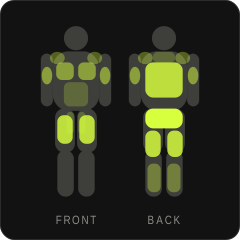
- Repeat-sprint ability
- Aerobic capacity (~12km/game)
- Hamstring durability
- Overhead marking power
| Session | Type | Duration | Focus |
|---|---|---|---|
| Speed Development | Conditioning | 45–50 min | Build genuine acceleration + top-end speed |
| Upper Power | Gym | 55–65 min | Overhead power + pressing/pulling strength |
| Game Engine | Conditioning | 45–50 min | Run out 4 quarters + back up repeat efforts |
| Game-Day Primer | Gym | 20–25 min | Explosive primer — sharp and short, no running or heavy legs before the game |
| Lower Power | Gym | 60–70 min | Triple-extension power + posterior-chain strength |
The season changes the program
Community footy runs on the same calendar as the AFL itself, so the app periodises to it out of the box. Pre-season is where the engine and the strength base get built; from March the job changes to backing up every Saturday without draining yourself.
- Pre-season
- November – February — set volume ×1.2. Build the engine and the strength base.
- In-season
- March – September — set volume ×0.7, prescribed weights hold. Maintain, don’t drain.
- Off-season
- October — baseline volume. Rebuild general strength and fix the niggles.
- Block structure
- Four-week blocks: three weeks accumulating, one week deload. The block’s character changes across the year rather than repeating.
- Game day
- Protected. The day before gets a 20-minute explosive primer with no running, no heavy legs and no prehab block bolted on.
The AFL testing battery
Five numbers, re-run every four weeks. Chosen to match what AFL programs actually measure — and the results re-price your training weights and reset your conditioning paces.
| Test | Measures | Unit |
|---|---|---|
| 2km time trial | The aerobic benchmark your program is built around. | mm:ss |
| Bench press 1RM | Upper-body pressing strength: the fend, the tackle, holding a bigger body off. | kg |
| Max pull-ups | Relative pulling strength — the best upper-body number there is for a field athlete. | reps |
| Trap-bar deadlift 1RM | Whole-body pulling strength — the lift that carries over to acceleration. | kg |
| Running vertical jump | What a marking or rebounding contest actually asks for. | cm |
What is actually in an AFL program
Every movement below appears in the sessions above, with the coaching cues the app shows you, the sets and reps it is prescribed at, and ranked alternatives if you cannot do it. The weight is calculated from your own last top set.
| Movement | Appears in | Why it is there | Trains |
|---|---|---|---|
| Box Jump | Lower Power | Vertical power for marking + ruck taps | Quads · Glutes · Calves |
| Bulgarian Split Squat | Lower Power | Single-leg power + change of direction | Quads · Glutes |
| Copenhagen Hold (long) | Lower Power | Adductor strength at full length — groin strain is a top-three injury in every cutting sport, and this is the position it happens in | Groin / Adductors · Abs / Core |
| Front Squat | Lower Power | Quad and trunk strength in the upright posture sport actually loads | Quads · Glutes |
| Hang Power Clean | Lower Power | Triple extension = sprint acceleration | Quads · Glutes · Hamstrings · Traps |
| Nordic Curl | Lower Power | Hamstring injury prevention — the #1 AFL injury | Hamstrings |
| Nordic Hamstring Lower | Lower Power | The most-evidenced hamstring exercise there is, done as a slow lower into a hold rather than a fall | Hamstrings |
| Sliding Leg Curl — eccentric hold | Lower Power | Hamstring eccentric with the hip extended — the sprinting position, which a Nordic on its knees never loads | Hamstrings |
| Trap Bar Deadlift | Lower Power | Foundational power output | Hamstrings · Glutes · Back |
| Trap Bar Jump | Lower Power | A loaded jump — peak power output with no barbell skill to learn first | Quads · Glutes · Calves |
| Bench Press | Upper Power | Pushing strength in contests | Chest · Triceps |
| Cable External Rotation — end-range hold | Upper Power | The rotator cuff loaded where it actually fails — at the end of the range, decelerating the arm after the ball has gone | Shoulders |
| DB Bent-Over Row | Upper Power | Posterior chain + back health | Back · Biceps |
| DB Pullover — stretch hold | Upper Power | Lat length and thoracic extension held at end range — overhead room for reaching, marking and throwing | Back |
| Med Ball Chest Pass | Upper Power | Upper-body power with no deceleration phase — you release instead of stopping | Chest · Triceps |
| Push Press | Upper Power | Overhead marking + ruck contests | Shoulders |
| Weighted Chin-Up | Upper Power | Contested marking + tackle strength | Back · Biceps |
| Weighted Dead Hang | Upper Power | Decompresses the spine and loads the shoulder at full overhead range — the cheapest overhead flexibility work there is | Back · Biceps |
| Weighted Dip | Upper Power | Heavy pressing that loads the triceps and lower chest together | Chest · Triceps |
Staying available
The prehab block is matched to the region of the session it sits in and to the tissue this sport actually punishes — not a generic mobility flow bolted to the front.
Prehab only works if it happens, and the reason it usually does not is that it has nothing to do with the session it is attached to. Rotating a pool by session number puts shoulder work before a squat day and Copenhagen planks before a bench press. Technically covered; nobody does it.
In Train Smart each movement is classified by the region it protects and matched to the session, and the pool rotates across the week so you cover all of it rather than doing the same three moves three times.
More on prehab that people actually do →
What the free month covers, and what comes after
The first month is one complete four-week block — three building weeks and a deload. The first retest comes after that block, and it is the first time the program measures what your training did.
- Week 1
- Testing session on the AFL battery. Your starting weights and paces come from it.
- Weeks 1–3
- The first block builds. Hit your reps and the weight goes up on its own.
- Week 4
- Deload — the week the previous three become fitness.
- Week 5
- Retest. The results re-price your weights and reset your conditioning paces.
- Weeks 5–8
- Block two changes shape, priced from the top sets you just did and the numbers you just tested.
Footy guides for your part of Australia
The pathway club your address is zoned to, the leagues you play in, when your season really starts and what the weather does to a pre-season — region by region, with sources.
AFL training questions
What does the Train Smart AFL program include?
When is AFL pre-season?
Can I follow this program if I only train twice a week?
What tests does the AFL program use?
Do I need a full gym?
Related
AFL pre-season program
Gym, running and skills around your club nights, from October to round one — and what to test.
OpenPrescribed weights
How every set gets a number in kilos, and why it climbs on its own.
OpenConditioning plans
Goal-driven running with a working pace recalculated every week.
OpenThe AFL pathway
How selection works in Australia, what gets tested, and what separates athletes who move up.
OpenGet your AFL program
Pick AFL, answer eight questions, and your week is built — around your team nights, your game and the days you can actually train.
Your first month is free, with nothing to pay today. Then A$24.99/month, cancel any time. On the App Store and Google Play.
- Install itFree to download on iPhone and Android.
- Tell it how you playYour sport, your season, the nights you train and the kit you have. No account needed.
- See your week, then start freeYour program is built before you pay anything. Start the free month to unlock it, and cancel any time in your store settings.