Bicep and grip exercises, and where they earn their place
Arm work is the first thing cut when a session runs long, which is why most amateur programs contain none of it by the time it reaches the athlete. The programs here treat it as a guaranteed slot rather than an optional extra, at a volume matched to what the sport actually uses.
Direct arm work has a smaller place in a sport program than in a bodybuilding one, but it is not zero. Curls and chin-up variants build elbow-flexor strength that matters in grappling, tackling and climbing; dead hangs, carries and wrist work build the grip and forearm endurance that decides whether the rest of the strength can be applied.
Train Smart guarantees arm work appears in the week rather than leaving it to be trimmed when a session runs short — which is what happens to it in most templates.
What bicep training is for in a sport program
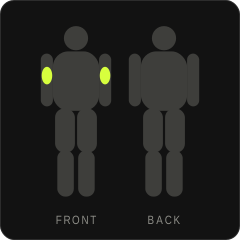
Elbow flexion under load. In grappling and contact sports the biceps work isometrically and eccentrically — holding a grip, resisting an arm being pulled straight. Chin-ups and curl variants build the strength that job needs.
Grip. Grip is the limiter on carries, deadlifts and rows long before the target muscle is. Dead hangs, towel work and carries are programmed for grip endurance specifically, and they show up in the sports where a contest is won with the hands.
Wrist and forearm prehab. Wrist extensor eccentrics and roller work appear in sports that load the wrist repeatedly — gymnastics, boxing, combat sports — where the forearm is a common site of overuse.
14 bicep movements in Train Smart
Every one of these is prescribed in at least one sport program, carries coaching cues written for the moment you are standing in front of it, and lists ranked alternatives. The sets, reps and load each is programmed at are on its own page.
Upper body
| Movement | Why it is in the program | Also trains |
|---|---|---|
| Weighted Chin-Up | Contested marking + tackle strength | Back |
| Weighted Pull-Up | Wrestle + grip strength | Back |
| Chest-Supported Row | Upper-back strength + posture | Back |
| Lat Pulldown | Back width + pulling strength | Back |
| Barbell Row | Mid-back strength — what holds posture together late in a game | Back |
| Chin-Up (or Band-Assisted) | The best test of upper-body relative strength | Back |
| DB Bent-Over Row | Posterior chain + back health | Back |
| Eccentric Chin-Up — dead-hang finish | Loads the elbow and biceps tendon at full length under control — the tendon that complains in every grappling, climbing and bar sport | Back |
| EZ-Bar Curl | Biceps mass | — |
| Gi / Towel Row | Grip + back endurance specific to grappling | Back |
| Inverted Row (under a table or bar) | Back + biceps strength — no bar? use a sturdy table edge | Back |
Full body and explosive
| Movement | Why it is in the program | Also trains |
|---|---|---|
| Weighted Dead Hang | Decompresses the spine and loads the shoulder at full overhead range — the cheapest overhead flexibility work there is | Back |
| Wrist Extensor Eccentric — end-range hold | The wrist and forearm loaded eccentrically — the only thing shown to fix a stubborn tennis elbow, and the joint every hand-plant and stick sport punishes | — |
| MB Rotational Throw | Hitting + slap-shot power | Back |
Which programs lean on the biceps hardest
Counted from the movements above — how many of them appear in each sport's own sessions. It is a measure of emphasis, not of importance.
| Program | Biceps movements in it |
|---|---|
| bodybuilding | 5 |
| gymnastics | 4 |
| general fitness | 4 |
| bodyweight training | 4 |
| AFL | 3 |
| MMA | 3 |
| basketball | 3 |
| hockey | 2 |
The tests that reflect bicep training
Train Smart re-runs a five-test battery every eight weeks and re-prices your training weights from the results. These are the tests in it that this work moves.
Biceps training questions
How many bicep exercises should be in a week?
What weight should I use for bicep exercises?
Can I swap one of these bicep exercises out?
Biceps work, in a program that knows where it goes
Train Smart puts these movements in the right session, at the right point in your four-week block, at a weight calculated from your own last top set — and swaps them automatically if you do not have the kit.
One month free, then A$24.99/month. Cancel any time. iPhone and iPad.