Chest exercises, and how much pressing a sport needs
Pressing is the most over-programmed pattern in amateur training and one of the least sport-specific. That does not make it useless — it makes it something to dose deliberately rather than by preference.
Chest training in a sport program means horizontal pressing: barbell and dumbbell bench variants, dips and push-up progressions, plus explosive work like the medicine-ball chest throw where the sport rewards it. In collision sports the bench press is a genuine performance lift; in most others it is general upper-body strength and is programmed as such.
Train Smart matches or exceeds pressing volume with pulling volume in every sport, which is why the chest appears less often than the back across the programs.
What chest training is for in a sport program
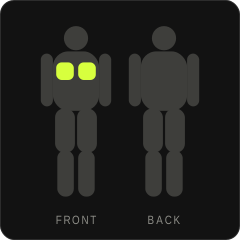
Where it genuinely transfers. In rugby league, rugby union, MMA and boxing, horizontal pressing strength shows up in contact. These sports carry the highest pressing volume in the programs, and the bench press is in their testing battery.
Where it is general strength. In running and court sports, chest work is there to build and maintain upper-body strength and mass, not because pressing wins games. It is programmed at a volume that leaves room for the work that does.
Explosive pressing. Medicine-ball chest throws appear where the sport asks for a fast press — a fend, a shove, a chest pass. They load the same pattern at a speed a barbell cannot reach.
10 chest movements in Train Smart
Every one of these is prescribed in at least one sport program, carries coaching cues written for the moment you are standing in front of it, and lists ranked alternatives. The sets, reps and load each is programmed at are on its own page.
Upper body
| Movement | Why it is in the program | Also trains |
|---|---|---|
| Incline DB Press | Upper strength for shielding the ball | Triceps |
| Weighted Dip | Heavy pressing that loads the triceps and lower chest together | Triceps |
| Bench Press | Pushing strength in contests | Triceps |
| Dip — bottom stretch hold | Pec and front-shoulder length under real load — the range a press never visits and a fall or a hand-off finds immediately | Triceps |
| Pike Push-Up | Overhead pressing strength for handstands | Triceps |
| Push-Up | Upper strength for lifts + partner work | Triceps |
| Barbell Bench Press | Primary chest mass + pressing strength | Triceps |
| DB Bench Press | Upper-body pushing strength | Triceps |
| DB Fly — stretch hold | Pec length at end range under load — the tissue that shortens on everyone who benches and presses | Triceps |
Full body and explosive
| Movement | Why it is in the program | Also trains |
|---|---|---|
| Med Ball Chest Pass | Upper-body power with no deceleration phase — you release instead of stopping | Triceps |
Which programs lean on the chests hardest
Counted from the movements above — how many of them appear in each sport's own sessions. It is a measure of emphasis, not of importance.
| Program | Chest movements in it |
|---|---|
| bodybuilding | 4 |
| bodyweight training | 4 |
| general fitness | 3 |
| AFL | 3 |
| soccer | 2 |
| boxing | 2 |
| MMA | 2 |
| gymnastics | 2 |
The tests that reflect chest training
Train Smart re-runs a five-test battery every eight weeks and re-prices your training weights from the results. These are the tests in it that this work moves.
Chest training questions
How many chest exercises should be in a week?
What weight should I use for chest exercises?
Can I swap one of these chest exercises out?
Chest work, in a program that knows where it goes
Train Smart puts these movements in the right session, at the right point in your four-week block, at a weight calculated from your own last top set — and swaps them automatically if you do not have the kit.
One month free, then A$24.99/month. Cancel any time. iPhone and iPad.