Quad exercises, and the job each one does
Almost every lower-body session in Train Smart opens with a knee-dominant lift. It is the most reliable way to load an athlete heavily and safely, and the quality it builds — force into the ground through an extending knee — is the one every running and jumping sport is built on.
The quadriceps extend the knee, which makes them the muscle group that produces force on the way up out of a squat, a jump or a step — and, just as importantly, the group that absorbs it on the way down. Squat variants (back, front, goblet, box) build the force; split squats, lunges and step-ups build it one leg at a time; tempo and pause work builds the eccentric strength that landing demands.
Quad work is in every Train Smart sport program. What changes by sport is the emphasis: jumping sports bias toward explosive and reactive work, collision sports toward heavy bilateral strength.
What quad training is for in a sport program
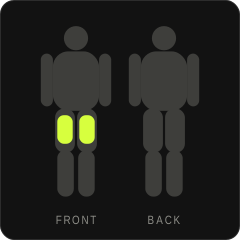
Force production. Squat variants are the backbone of the lower-body program because they load the most muscle at once. Which variant appears depends on the sport and the block: a front squat biases the quad and the trunk, a box squat controls depth, a pause squat removes the bounce.
Force absorption. Tempo work — a three-second lowering phase — is in the program for a reason unrelated to how it feels. The eccentric side of the lift is the side that matches landing and deceleration, and it is deliberately prescribed at points in the block where the nervous-system cost of heavy lifting needs to come down without the training stopping.
One leg at a time. Split squats, Bulgarians, lunges and step-ups appear alongside the bilateral lifts rather than instead of them. A two-legged squat hides a side-to-side difference; a split squat does not.
38 quad movements in Train Smart
Every one of these is prescribed in at least one sport program, carries coaching cues written for the moment you are standing in front of it, and lists ranked alternatives. The sets, reps and load each is programmed at are on its own page.
Lower body
| Movement | Why it is in the program | Also trains |
|---|---|---|
| Front Squat | Quad and trunk strength in the upright posture sport actually loads | Glutes |
| Bulgarian Split Squat | Single-leg power + change of direction | Glutes |
| Copenhagen Hold (long) | Adductor strength at full length — groin strain is a top-three injury in every cutting sport, and this is the position it happens in | Glutes |
| Back Squat | Base strength to win the collision | Glutes |
| Broad Jump | Horizontal shot power on the double-leg | Glutes · Shoulders |
| Goblet Cossack Squat — deep hold | Adductor and hip length under load, held in the deepest position — the shape a cut or a lunge actually asks for | Glutes |
| Goblet Squat | Base leg strength | Glutes |
| Hang Power Clean | Triple extension = sprint acceleration | Glutes · Shoulders |
| Hang Power Snatch | The fastest lift in the gym — trains rate of force development directly | Glutes · Shoulders |
| Box Jump | Vertical power for marking + ruck taps | Glutes · Shoulders |
| Deep Goblet Squat Hold | Loaded end-range hip, knee and ankle at once — the bottom position, held long enough to change it | Glutes |
| Lateral Bound | Change-of-direction power | Glutes · Shoulders |
| Lateral Bound → Stick | Controlled change of direction | Glutes · Shoulders |
| Loaded Adductor Frog Hold | Deep abduction and adductor length held long enough to change it — the base position for guard work, low blocks and wide bases | Glutes |
| Power Clean | Whole-body explosive power | Glutes · Shoulders |
| Reverse Nordic — hold at length | Quad and hip-flexor length under load — the other half of the Nordic, and the range a sprinter runs out of first | — |
| Sissy Squat — bottom hold | Loads the quad and the knee in full flexion — the position a deep landing, a lunge for a ball or a low turn puts it in | — |
| Adductor Slide-Out — eccentric | The groin taken out to length under its own control — the exact mechanism of a reaching tackle or an overstretched stride | Glutes |
| Barbell Back Squat | Base lower-body strength — bowling drive + batting stance | Glutes |
| Countermovement Jump | Builds the jump height behind leaps + grand jetés | Glutes · Shoulders |
| Depth Drop → Rebound | Reactive power off the floor | Glutes · Shoulders |
| Depth Drop → Stick | Deceleration + ACL-safe landing | Glutes · Shoulders |
| Drop Landing → Stick | Trains the safe landing that prevents ACL tears | Glutes · Shoulders |
| Overhead Squat Hold | Ankle, hip and shoulder range in one chain, held long enough to expose and then change the limiting one | Glutes |
| Pause Squat Jump | Concentric-only jump — pure starting strength | Glutes |
| Single-Leg Hop → Stick | Single-leg landing control on the catch | Glutes · Shoulders |
| Spanish Squat — long isometric | A long knee-extensor isometric, the first-line loading for a sore patellar tendon and the cheapest jumper's-knee insurance there is | Glutes |
| Split Jump → Stick | Trains the soft, controlled landing that protects ankles + knees | Glutes · Shoulders |
| Sprint | Top-end speed — the most athletic quality there is | Glutes |
| Squat Jump | Explosive leg power for jumping + sprinting | Glutes |
| Tuck Jump | Reactive power + fast feet | Glutes · Shoulders |
| Vertical Jump → Stick | Triple-extension power that feeds punch force | Glutes · Shoulders |
Full body and explosive
| Movement | Why it is in the program | Also trains |
|---|---|---|
| Loaded 90/90 — hold each side | Internal and external hip rotation held at end range — the range that runs out first in cutting sports | Glutes |
| KB Windmill — bottom hold | Hip hinge, thoracic rotation and an overhead shoulder held in one shape | Glutes |
| MB Rotational Slam | The hip rotation behind a heavy cross + hook | Glutes · Shoulders |
| Med Ball Overhead Slam | Full-body extension into the ground, and it stays honest under fatigue | Glutes · Shoulders |
| Slow Eccentric Step-Down | Eccentric knee control on one leg — the quality that decides whether a landing or a deceleration is absorbed or survived | Glutes |
| Weighted Couch Stretch | The hip flexor and quad at full length, loaded, which is where a long season leaves them shortest | Calves |
Which programs lean on the quads hardest
Counted from the movements above — how many of them appear in each sport's own sessions. It is a measure of emphasis, not of importance.
| Program | Quads movements in it |
|---|---|
| bodyweight training | 11 |
| cricket | 8 |
| rugby league | 6 |
| MMA | 6 |
| AFL | 5 |
| rugby union | 5 |
| netball | 5 |
| dance | 5 |
The tests that reflect quad training
Train Smart re-runs a five-test battery every eight weeks and re-prices your training weights from the results. These are the tests in it that this work moves.
Quads training questions
How many quad exercises should be in a week?
What weight should I use for quad exercises?
Can I swap one of these quad exercises out?
Quads work, in a program that knows where it goes
Train Smart puts these movements in the right session, at the right point in your four-week block, at a weight calculated from your own last top set — and swaps them automatically if you do not have the kit.
One month free, then A$24.99/month. Cancel any time. iPhone and iPad.